
By Team Neeraj Associates, Lucknow · Last reviewed: November 2026 · 14 min read
हिंदी में पढ़ें: ट्रेडमार्क पंजीकरण की पूरी प्रक्रिया — हिंदी गाइड
Quick answer: Under the Trade Marks Act, 1999 and the Trade Marks Rules, 2017, every trade mark application in India follows a fixed route. There are two stages.
Stage I (filing and formality check):
- Filing on Form TM-A
- Digitisation, and Vienna codification for logos
- Formality check. An incomplete application gets a deficiency notice, and if the defect is not cured, the application is abandoned.
Stage II (examination to registration):
- Examination under Sections 9, 11 and 13
- Reply to the examination report within 30 days, and a show cause hearing if objections remain
- Acceptance and publication in the Trade Marks Journal
- A 4-month window for opposition, followed by opposition proceedings if a notice is filed
- Registration
Registration lasts 10 years and is renewable on Form TM-R. The ™ symbol may be used from filing, but ® only after registration.
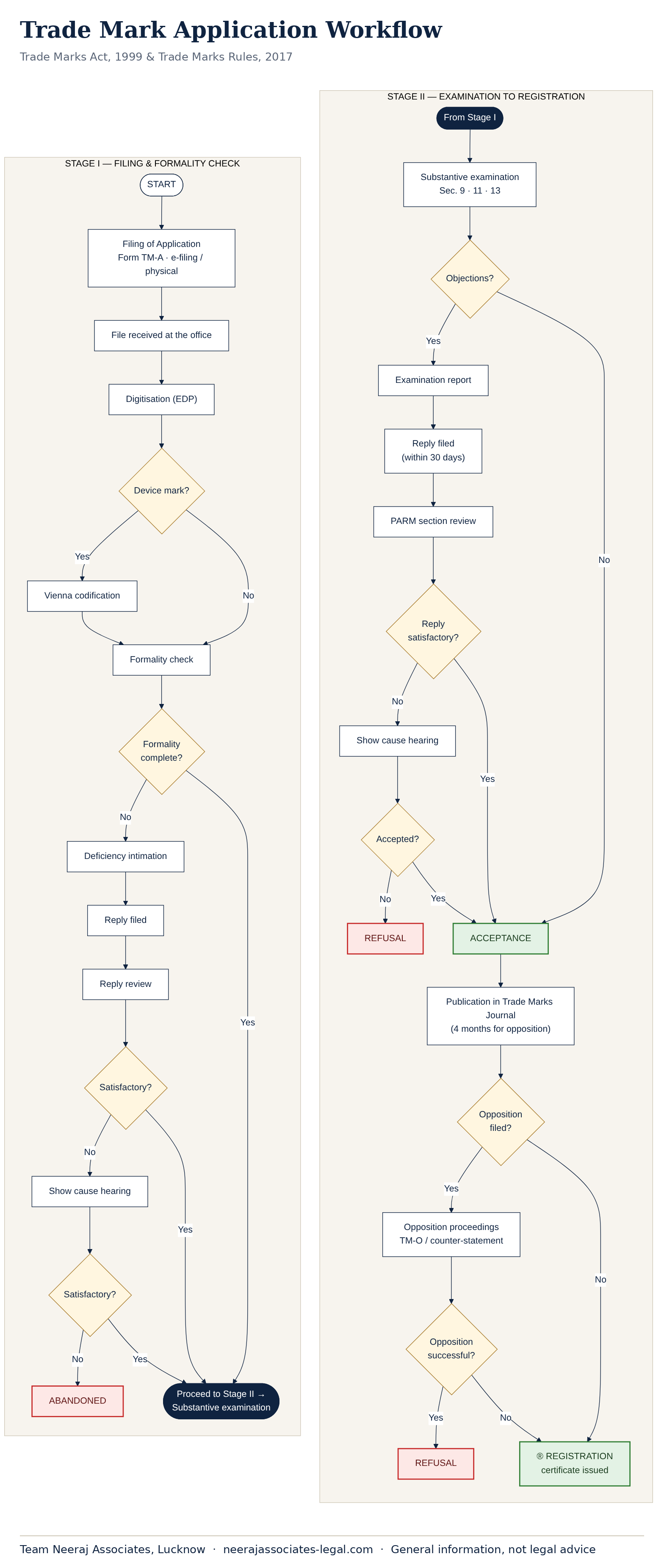
Before you file: four decisions that shape the whole process
Most problems in the workflow below start before the application is filed. Settle these four points first.
What can be registered
A trade mark is any mark that can be represented graphically and that distinguishes one person's goods or services from another's (Section 2(1)(zb)). Common types are:
- Word marks: a brand name in plain text. This gives the widest protection, regardless of font or style.
- Device or logo marks: a logo, label or stylised word.
- Other marks: shape of goods, packaging, colour combinations and sound marks.
- Special marks: collective marks and certification marks.
Search before filing
The register of trade marks is public and can be searched online on the IP India website. Look for identical and similar marks in the same and related classes, and consider phonetic similarity as well, because marks that sound alike can conflict. A good search is the cheapest way to avoid an objection under Section 11 or an opposition later.
Choosing the class
Goods and services are divided into 45 classes under the international (Nice) classification:
- classes 1 to 34 cover goods
- classes 35 to 45 cover services
Choose every class that covers what the business actually sells or plans to sell, and describe the goods or services clearly. A vague or overbroad specification often draws an objection.
Used or proposed to be used
If the mark is already in use, claim the date of first use and support it with a user affidavit and evidence such as invoices or advertisements. An earlier use date can be decisive in a dispute. If the mark has not been used yet, it is filed as "proposed to be used".
Stage I: Filing and formality check
Step 1: Filing the application (Form TM-A)
The application is filed on Form TM-A, online through the IP India e-filing portal or physically at the Trade Marks Registry. Points to note:
- Who can file: any person claiming to be the proprietor of the mark (Section 18), whether an individual, firm, LLP, company or trust.
- Several classes: one application may cover several classes, but a separate fee is payable for each class.
- Application number: generated on filing. From this date the applicant may use the ™ symbol with the mark.
- Agent or advocate: appointed through a Power of Attorney on Form TM-48, filed with the application.
- Priority: if the same mark was filed in a convention country within the last six months, priority can be claimed from that earlier date (Section 154).
Step 2: Receipt and digitisation
The Registry receives the file and enters its details into its electronic system (EDP). From here the application can be tracked online by its number.
Step 3: Vienna codification (logo marks only)
For a device or logo mark, the figurative elements are classified under the Vienna Classification, for example stars, animals, human figures or geometric shapes. This lets the Registry and the public search for similar logos. Word marks skip this step.
Step 4: Formality check
The Registry checks whether the application is complete:
- applicant's name, address, nationality and legal status
- class, and the description of goods or services
- the correct fee for each class
- Power of Attorney (TM-48), where an agent files
- user affidavit, where prior use is claimed
- a clear representation of the mark
Step 5: Deficiency intimation and reply
If something is missing or defective, the Registry issues a deficiency intimation. The applicant files a reply curing the defect, and the Registry reviews it. If the reply is satisfactory, the application moves on to examination.
Step 6: Show cause hearing and abandonment
If the reply is not satisfactory, a show cause hearing is fixed. If the defect is cured at or after the hearing, the application proceeds to substantive examination. If the defect remains, the application is treated as abandoned. An abandoned application gives no protection, and a fresh application with a new filing date would be needed.
Stage II: Examination to registration
Step 7: Substantive examination (Sections 9, 11 and 13)
The Examiner tests the mark on three sets of grounds.
Absolute grounds (Section 9). A mark may be refused if:
- it lacks distinctive character
- it consists only of words or signs that describe the kind, quality, quantity, intended purpose, value or geographical origin of the goods or services
- it has become customary in the trade
- it is likely to deceive or cause confusion
- it may hurt religious feelings, is scandalous or obscene, or is barred under the Emblems and Names (Prevention of Improper Use) Act, 1950
- for shape marks, the shape results from the nature of the goods, is needed to obtain a technical result, or gives substantial value to the goods
A mark that is descriptive on its face can still be registered if, before filing, it has acquired distinctiveness through use or is a well-known trade mark (proviso to Section 9(1)).
Relative grounds (Section 11). A mark may be refused if it is identical or similar to an earlier mark for identical or similar goods or services, and this is likely to confuse the public. Well-known marks get wider protection, even for different goods or services.
Section 13. A mark cannot be registered for a chemical substance or preparation if it is the name of a chemical element or an international non-proprietary name (INN), or is deceptively similar to one.
If the Examiner finds no objection, the application goes straight to acceptance. An applicant who needs a faster decision can request expedited examination under Rule 34, for a higher fee.
Step 8: Examination report and reply within 30 days
If objections are raised, the Registry issues an examination report. For Section 11 objections, it usually lists the conflicting marks found in the search. The applicant must file a reply within 30 days of receiving the report. If no reply is filed in time, the application can be treated as abandoned (Section 132).
A good reply answers each objection specifically. Depending on the objection, it may include:
- For Section 9 objections:
- arguments on why the mark is distinctive, or only suggestive rather than descriptive
- evidence of use to show acquired distinctiveness
- a disclaimer of a descriptive part (Section 17)
- For Section 11 objections:
- a comparison showing that the marks or the goods differ
- proof of the applicant's earlier use
- a plea of honest concurrent use (Section 12)
- a consent letter from the earlier owner
- narrowing the description of goods or services
Step 9: Review of the reply (PARM section)
The reply is reviewed in the PARM section of the Registry. If it is satisfactory, the mark is accepted and sent for publication. In some cases the Registrar may advertise the mark before acceptance (proviso to Section 20(1)). If the reply is not satisfactory, the matter is listed for a hearing.
Step 10: Show cause hearing
At the show cause hearing, the applicant or their advocate argues the case before the Registrar or Examiner, physically or by video conference. A request to adjourn the hearing can be made on Form TM-M. The hearing ends in:
- acceptance, sometimes with conditions, limitations or a disclaimer, or
- refusal, with reasons recorded
An order refusing registration can be appealed to the High Court within three months (Section 91).
Step 11: Acceptance and publication in the Trade Marks Journal
An accepted mark is advertised in the Trade Marks Journal (Section 20). The Journal is published online every week. Publication gives the public notice of the mark and starts the opposition period.
Step 12: Opposition (Section 21)
Any person may oppose the mark within 4 months of the date of the Journal. Opposition is usually based on an earlier similar mark, prior use, lack of distinctiveness or bad faith. The proceedings run as follows:
- Notice of Opposition: filed by the opponent on Form TM-O, with a fee for each class opposed.
- Counter-statement: filed by the applicant on Form TM-O within 2 months of receiving the notice. If no counter-statement is filed in time, the application is treated as abandoned (Section 21(2)).
- Evidence: both sides file evidence by affidavit:
- the opponent first (Rule 45)
- then the applicant (Rule 46)
- then the opponent's evidence in reply (Rule 47)
- Hearing and decision: the Registrar hears both sides and decides whether the mark should be registered.
An order in opposition proceedings can be appealed to the High Court.
Step 13: Registration
The mark is registered if no opposition is filed within 4 months, or if the opposition fails (Section 23). The registration certificate is issued, and the ® symbol may then be used.
- Date of registration: the date of the application, so protection runs from filing.
- Rights: a registered proprietor has the exclusive right to use the mark for the registered goods or services, and can sue for infringement (Sections 28 and 29).
After registration: renewal and upkeep
- Validity: 10 years from the date of application, renewable for further periods of 10 years (Section 25).
- Renewal: on Form TM-R, which can be filed up to one year before expiry.
- Late renewal:
- within 6 months after expiry, with a surcharge
- within one year after expiry, by restoration with a further fee
- after that, the mark is removed from the register
- Use it: a registered mark that has not been used for a continuous period of five years and three months can be removed for non-use on an application by an aggrieved person (Section 47).
- Keep records current: record changes of address, name or ownership (assignment) with the Registry.
- Challenges: even after registration, an aggrieved person can apply for rectification or cancellation on the grounds set out in the Act (Section 57).
Key forms and time limits
| Stage | Form | Time limit / remarks |
|---|---|---|
| Application for registration | TM-A | Separate fee for each class; one application may cover several classes |
| Appointment of agent or advocate | TM-48 | Filed with the application |
| Priority claim | In TM-A | Within 6 months of the convention application |
| Reply to examination report | Online reply | Within 30 days of receiving the report |
| Expedited examination | TM-M | Optional, under Rule 34 |
| Show cause hearing | — | Attend on the date fixed; adjournment on Form TM-M |
| Opposition (by a third party) | TM-O | Within 4 months of publication |
| Counter-statement (by the applicant) | TM-O | Within 2 months of receiving the notice of opposition |
| Evidence | Affidavit | Rules 45 to 47 |
| Appeal against Registrar's order | — | To the High Court, within 3 months |
| Renewal | TM-R | Every 10 years; can be filed up to one year before expiry |
Official fees (per class, e-filing)
| Item | Individual / startup / small enterprise | Others |
|---|---|---|
| Application (TM-A) | ₹4,500 | ₹9,000 |
| Opposition or counter-statement (TM-O) | ₹2,700 | ₹2,700 |
| Renewal (TM-R) | ₹9,000 | ₹9,000 |
| Renewal within 6 months after expiry (surcharge) | ₹4,500 plus renewal fee | ₹4,500 plus renewal fee |
| Restoration and renewal | ₹9,000 plus renewal fee | ₹9,000 plus renewal fee |
| Expedited examination (Rule 34) | ₹20,000 | ₹40,000 |
Physical filing costs more, for example ₹5,000 and ₹10,000 for an application. These fees are from the First Schedule to the Trade Marks Rules, 2017 and can be revised, so check the current schedule before filing. Professional fees are separate.
Documents needed for filing
- Name, address and nationality of the applicant, and its constitution (individual, proprietorship, partnership, LLP or company)
- Certificate of incorporation, partnership deed or LLP agreement, as applicable
- Udyam (MSME) or DPIIT startup certificate, to claim the lower fee
- The mark: the word, and the logo in JPG format for a device mark
- Description of the goods or services
- If prior use is claimed: the date of first use, and proof such as invoices or advertisements
- Signed Power of Attorney (TM-48), and a user affidavit where prior use is claimed
Tracking the application
The status of any application can be checked online on the IP India website using the application number. The status shows the stage the application has reached, for example:
- formality check
- marked for examination
- objected
- accepted and advertised
- opposed
- registered
- abandoned or refused
Check it regularly. Official communications and hearing notices are also sent by email, and a missed notice can cost the application.
Common mistakes that cause delay or loss
- Skipping the search. Filing without checking for similar marks invites a Section 11 objection or an opposition.
- Wrong or vague class description. The goods or services must match what the business actually does.
- Descriptive marks. Words that only describe the product or its quality usually face a Section 9 objection.
- Missing a deadline. Most applications are lost at two points:
- the 30-day reply to the examination report
- the 2-month counter-statement in an opposition
- Using ® too early. Representing an unregistered mark as registered is an offence (Section 107).
- Not renewing on time. Restoration is possible only for a limited period after expiry.
Frequently asked questions
Can I use my brand name after filing the application?
Yes. You may use the mark with the ™ symbol from the date of filing. The ® symbol can be used only after registration.
How long does registration take?
There is no fixed period. If there is no objection and no opposition, registration usually follows some months after the 4-month opposition window closes. Objections, hearings or an opposition can add considerable time, and the actual time depends on the Registry.
What happens if I miss the 30-day reply to the examination report?
The application can be treated as abandoned. Track the date of the report carefully and file the reply in time.
Should I register the word or the logo?
A word mark protects the name in any style, so it is usually the stronger first filing. A logo mark protects the design. Many businesses file for both.
Is a separate application needed for each class?
No. One application can cover several classes, but a separate fee is payable for each class.
Can a registered trade mark be challenged later?
Yes. A registered mark can face rectification or removal proceedings, including removal for non-use under Section 47.
Can I file an application myself?
Yes, an applicant can file on their own. Many applicants appoint an agent or advocate through Form TM-48 to handle replies, hearings and oppositions.
About the authors
Team Neeraj Associates, Lucknow Email: rishi.saxena@neerajassociates-legal.com · Phone: +91 8960006363
Questions on this guide? If you have a question about the law discussed here, write to rishi.saxena@neerajassociates-legal.com. Selected questions will be answered in future updates of this guide. We do not advise on individual matters through this website.
Disclaimer: This article is general information as of November 2026, not legal advice. If anything here differs from the Trade Marks Act, 1999, the Trade Marks Rules, 2017 or notifications under them, the law prevails. Stage-wise timelines are indicative, and actual processing time depends on the Registry. Please consult an advocate about your situation.
Disclaimer: This article is general information about Indian law and is not legal advice. Laws, rules and court rulings change, and your situation may differ. Please consult an advocate before acting.